Monday, 11 May 2015

Causes and effects of improper waste management.

CAUSES

Contributing causes of improper waste management are:
Ignorance: Ignorance of people about proper waste disposal. People are unaware of consequence of their unwise acts.
Laziness: Can cause improper garbage disposal because People not following the correct rules of proper waste disposal their always throw it what place they want and they have no care what will be the effect of it.
Greed: Can cause improper garbage disposal for example burning of tires of wheel and plastic instead of keeping it or trade the excess automobile car tires to maximize on it.

Overview

Tossing everyday items into the trash can seem like second nature to many people. If you are implementing recycling techniques into your lifestyle, you are taking a positive step toward helping the environment. Learner.org notes that in the U.S. alone, over 230 million tons of trash is produced each year. Less than 25 percent of that waste is recycled and the rest ends up in landfills, incinerated or in ditches and roadsides. Improper garbage disposal isn’t just an eyesore; it poses a serious threat to nature.

Soil Contamination

It is important to learn the basics of recycling so that the waste that does end up in landfills can be disposed of properly. Plastics, metals, papers and certain types of glass can all be recycled at your local recycling center. If you take the time to send these items to recyclable locations, the items can be reused and returned to consumers. They won’t end up as trash or hurting the environment. If recyclables are placed into the ground they can potentially contaminate the surrounding soil. The Western Courier shares with readers that as plastic water bottles break down they can release DEHA, a type of carcinogen that can cause reproductive problems, liver issues and weight loss. This type of chemical can leach into the soil and cause contamination that can reach plant and animal life as well as water sources. Newspapers or paper that contains ink can be toxic to the soil as well. If the garbage is dumped or not contained properly in a landfill it will contaminate the surrounding ground.

Air Contamination

When disposing of garbage that contains harmful chemicals such as bleach, acid or oil it is important that it is disposed of in approved containers and labeled correctly. Paper, plastics and other materials that are burned can contaminate the air when they are burned. Over time the chemicals can build up in the ozone layer. If they contain toxic chemicals like dioxin they can reach the air that people breathe and cause a public health risk. Garbage that is disposed of improperly can also begin to release methane gases. According to the Energy Information Administration, these gases are greenhouse gasses that can destroy the earth’s ozone layer and contribute to significant climate changes or global warming.

Animals and Marine Life

Humans are not the only ones affected by improper garbage disposal—animals are too. Conservation International notes that garbage dumping and discharging raw or untreated sewage can threaten marine life and animals who come in contact with the water. When waste forms a cluster or algal bloom, the area can suffocate and contaminate sea bottom habitats such as coral and fish reducing their numbers. This contamination not only destroys their habitat it can also affect human consumption as fish and shellfish that were feasting off of contaminated areas reach fishermen and are caught for human consumption. Old fishing lures, plastic bottles, rope, Styrofoam, cigarette butts and fishing lines can be consumed by marine animals leading to the death of millions each year according to Conservation International.

Role of social worker in protection and preservation of environment .

v  Creating awareness among the public on current environmental issues and solutions.
v  Facilitating the participation of various categories of stakeholders in the discussion on environmental issues.
v  Conducting participatory rural appraisal.
v  Being involved in the protection of human rights to have a clean environment.
v  Protecting the natural resources and entrusting the equitable use of resources.
v  Data generation on natural resources, time line history of villages.
v  Analysis and monitoring of environmental quality.
v  Transferring information through newsletters, brochures, articles, audio visuals, etc.
v  Organizing seminars, lectures and group discussion for promotion of environmental awareness.
v  Helping the villages’ administrative officials in preparation, application and execution of projects on environmental protection.

Ecological succession and its various stages .

Ecological succession is the observed process of change in the species structure of an ecological community over time. The time scale can be decades (for example, after a wildfire), or even millions of years after a mass extinction.  The community begins with relatively few pioneering plants and animals and develops through increasing complexity until it becomes stable or self-perpetuating as a climax community. The ʺengineʺ of succession, the cause of ecosystem change, is the impact of established species upon their own environments. A consequence of living is the sometimes subtle and sometimes overt alteration of one's own environment.  It is a phenomenon or process by which an ecological community undergoes more or less orderly and predictable changes following a disturbance or the initial colonization of a new habitat. Succession may be initiated either by formation of new, unoccupied habitat, such as from a lava flow or a severe landslide, or by some form of disturbance of a community, such as from a fire, severe windthrow, or logging. Succession that begins in new habitats, uninfluenced by pre-existing communities is called primary succession, whereas succession that follows disruption of a pre-existing community is called secondary succession.  Succession was among the first theories advanced in ecology. The study of succession remains at the core of ecological science. Ecological succession was first documented in the Indiana Dunes of Northwest Indiana which led to efforts to preserve the Indiana Dunes. Exhibits on ecological succession are displayed in the Hour Glass, a museum in Ogden Dunes.
Ecological succession is the gradual process by which ecosystems change and develop over time. Nothing remains the same and habitats are constantly changing.There are two main types of succession, primary and secondary.

Primary succession is the series of community changes which occur on an entirely new habitat which has never been colonized before. For example, a newly quarried rock face or sand dunes.

Secondary succession is the series of community changes which take place on a previously colonized, but disturbed or damaged habitat. For example, after felling trees in a woodland, land clearance or a fire.


The Major Points:
  • The species living in a particular place gradually change over time as does the physical and chemical environment within that area.
  • Succession takes place because through the processes of living, growing and reproducing, organisms interact with and affect the environment within an area, gradually changing it.
  • Each species is adapted to thrive and compete best against other species under a very specific set of environmental conditions. If these conditions change, then the existing species will be outcompeted by a different set of species which are better adapted to the new conditions.
  • The most often quoted examples of succession deal with plant succession. It is worth remembering that as plant communities change, so will the associated micro-organism, fungus and animal species. Succession involves the whole community, not just the plants.
  • Change in the plant species present in an area is one of the driving forces behind changes in animal species. This is because each plant species will have associated animal species which feed on it. The presence of these herbivore species will then dictate which particular carnivores are present.
  • The structure or 'architecture' of the plant communities will also influence the animal species which can live in the microhabitats provided by the plants.
  • Changes in plant species also alter the fungal species present because many fungi are associated with particular plants. 
  • Succession is directional. Different stages in a particular habitat succession can usually be accurately predicted.
  • These stages, characterised by the presence of different communities, are known as 'seres'.
  • Communities change gradually from one sere to another. The seres are not totally distinct from each other and one will tend to merge gradually into another, finally ending up with a 'climax' community.
  • Succession will not go any further than the climax community. This is the final stage.

    This does not however, imply that there will be no further change. When large organisms in the climax community, such as trees, die and fall down, then new openings are created in which secondary succession will occur.
  • Many thousands of different species might be involved in the community changes taking place over the course of a succession. For example, in the succession from freshwater to climax woodland.
  • The actual species involved in a succession in a particular area are controlled by such factors as the geology and history of the area, the climate, microclimate, weather, soil type and other environmental factors.

    For example, the species involved in a succession from open freshwater to climax woodland in Central Africa, would be quite different to those which have been quoted in these pages as occurring in Britain. However, the processes involved would be the same.
Succession occurs on many different timescales, ranging from a few days to hundreds of years.

  • It may take hundreds of years for a climax woodland to develop, while the succession of invertebrates and fungi within a single cow pat (cow dung), may be over within as little as 3 months.

    By this time, the dung has been transformed into humus and nutrients and has been recycled back into the soil. The holes clearly visible in the cow pat (right) have been made by the animals which have colonized it.


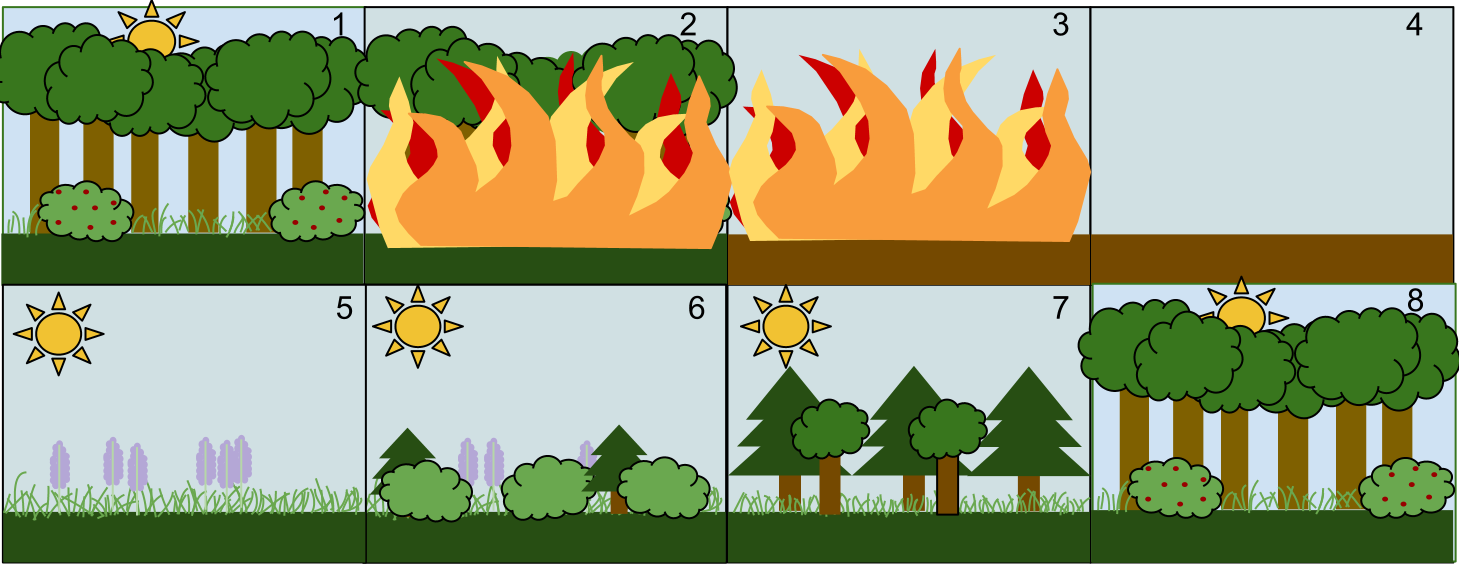
    An example of Secondary Succession by stages: 1. A stable deciduous forest community 2. A disturbance, such as a wild fire, destroys the forest 3. The fire burns the forest to the ground 4. The fire leaves behind empty, but not destroyed, soil 5. Grasses and other herbaceous plants grow back first 6. Small bushes and trees begin to colonize the area 7. Fast growing evergreen trees develop to their fullest, while shade-tolerant trees develop in the understory 8. The short-lived and shade intolerant evergreen trees die as the larger deciduous trees overtop them. The ecosystem is now back to a similar state to where it began.


    Stages of Ecological Succession

    When talking about the types of ecological succession it is important to remember that the “types” occur within the stages, but they may not necessarily be unique to that stage. What determines the stage that an ecosystem is in is dependent on its energy balance – which is discussed in the next section. There are four main types of ecological succession:
    • Pioneer – pioneer types are the new lifeforms that enter into a primary succession and begin to take hold. This can be anything from a seed to a bacteria to an insect or to an animal wandering into a new area and bedding down to make it their home. The pioneer has no connection to the environment, but it does find enough present in the new ecosystem to begin to establish its life.
    • Establishing – the establishing type can be hard to pinpoint because it crosses into the pioneer and sustaining. Establishing is the process in which lifeforms identify elements in an ecosystem that can sustain their basic needs – such as food, water and safe habitat.
    • Sustaining – Sustaining type means that life in the ecosystem has begun to enter into a pattern that allows for a cycle of life to continue. This means that birth and death are occurring, and there is little migration outside of the ecosystem – this is most common in the climax succession.
    • Producing – the producing type occurs during the secondary succession. This is when lifeforms are breeding and growing, but there is migration because what is produced is also not capable of being supported within the ecosystem. There are also more areas of overgrowth or overpopulation due to seed levels.
    Pioneer species are the ones that thrive the new habitat at the beginning of ecological succession. Pioneer species are ‘r-selected’ species that are fast growing and well-dispersed. Early succession is therefore dominated by so called ‘r-selected’ species. As succession continues, more species enter the community and begin to alter the environment. These are called ‘k-selected’ species. They are more competitive and fight for resource and space. The species that are better suited for the modified habitat then begin to succeed the other species. These are superseded by newer set of species. This goes on till the stage of climax or equilibrium is achieved.
    When succession reaches a climax, where community is dominated by stable and small number ofprominent species and no other species can be admitted, that is called the  state of equilibrium or the climax community.

Social ecology , objectives and challenges .

Social Ecology is a critical social theory founded by Green author and activist Murray Bookchin. Conceptualized as a critique of current social, political, and anti-ecological trends, it espouses a reconstructive, ecological, communitarian, and ethical approach to society. This version advocates a reconstructive and transformative outlook on social and environmental issues, and promotes adirectly democratic, confederal politics. As a body of ideas, social ecology envisions a moral economy that moves beyond scarcity and hierarchy, toward a world that reharmonizes human communities with the natural world, while celebrating diversity, creativity and freedom. Bookchin suggests that the roots of current ecological and social problems can be traced to hierarchical (or more specifically kyriarchical) modes of social organization. Social ecologists claim that the systemic issue of hierarchy cannot be resisted by individual actions alone such as ethical consumerism but must be addressed by more nuanced ethical thinking and collective activity grounded in radically democratic ideals. The complexity of relationships between people and nature is emphasized, along with the importance of establishing more mutualistic social structures that take account of this.


What defines social ecology as social is its recognition of the often-overlooked fact that nearly all our present ecological problems arise from deep-seated social problems. Conversely, our present ecological problems cannot be clearly understood, much less resolved, without resolutely dealing with problems within society. To make this point more concrete; economic, ethnic, cultural, and gender conflicts, among many others, lie at the core of the most serious ecological dislocations we face today — apart, to be sure, from those that are produced by natural catastrophes.
If this approach seems a bit too sociological for those environmentalists who identify the primary ecological problem as being the preservation of wildlife or wilderness, or more broadly as attending to “Gaia” to achieve planetary “oneness,” they might wish to consider certain recent developments. The massive oil spill by an Exxon tanker at Prince William Sound, the extensive deforestation of redwood trees by the Maxxam Corporation, and the proposed James Bay hydroelectric project that would flood vast forested areas of northern Quebec, to cite only a few problems, are sobering reminders that the real battleground on which the ecological future of the planet will be decided is clearly a social one.
Indeed, to separate ecological problems from social problems — or even to play down or give only token recognition to their crucial relationship — would be to grossly misconstrue the sources of the growing environmental crisis. In effect, the way human beings deal with each other as social beings is crucial to addressing the ecological crisis. Unless we clearly recognize this, we will surely fail to see that the hierarchical mentality and class relationships that so thoroughly permeate society are what has given rise to the very idea of dominating the natural world.
Unless we realize that the present market society, structured around the brutally competitive imperative of “grow or die,” is a thoroughly impersonal, self-operating mechanism, we will falsely tend to blame other phenomena — technology as such or population growth as such — for environmental problems. We will ignore their root causes, such as trade for profit, industrial expansion, and the identification of progress with corporate self-interest. In short, we will tend to focus on the symptoms of a grim social pathology rather than on the pathology itself, and our efforts will be directed toward limited goals whose attainment is more cosmetic than curative.
Some critics have recently questioned whether social ecology has treated the issue of spirituality in ecological politics adequately, but social ecology was in fact among the earliest of contemporary ecologies to call for a sweeping change in existing spiritual values. Such a change would be a far-reaching transformation of our prevailing mentality of domination into one of complementarity, one that sees our role in the natural world as creative, supportive, and deeply appreciative of the needs of nonhuman life. In social ecology a truly “natural” spirituality would center on the ability of an awakened humanity to function as moral agents for diminishing needless suffering, engaging in ecological restoration, and fostering an aesthetic appreciation of natural evolution in all its fecundity and diversity.
Thus, in its call for a collective effort to change society, social ecology has never eschewed the need for a radically new spirituality or mentality. As early as 1965, the first public statement to advance the ideas of social ecology concluded with the injunction: “The cast of mind that today organizes differences among human and other life-forms along hierarchical lines of ‘supremacy or ‘inferiority’ will give way to an outlook that deals with diversity in an ecological manner — that is, according to an ethics of complementarity.”1 In such an ethics, human beings would complement nonhuman beings with their own capacities to produce a richer, creative, and developmental whole — not as a “dominant” species but as supportive one. Although this ethics, expressed at times as an appeal for the “respiritization of the natural world,” recurs throughout the literature of social ecology, it should not be mistaken for a theology that raises a deity above the natural world or even that seeks to discover one within it. The spirituality advanced by social ecology is definitively naturalist (as one would expect, given its relation to ecology itself, which stems from the biological sciences) rather than supernaturalistic or pantheistic.
The effort in some quarters of the ecology movement to prioritize the need to develop a pantheistic “eco-spirituality” over the need to address social factors (which actually erode all forms of spirituality) raises serious questions about their ability to comes to grips with reality. At a time when a blind social mechanism, the market, is turning soil into sand, covering fertile land with concrete, poisoning air and water, and producing sweeping climatic and atmospheric changes, we cannot ignore the impact that a hierarchical and class society has on the natural world. We must face the fact that economic growth, gender oppressions, and ethnic domination — not to speak of corporate, state, and bureaucratic interests — are much more capable of shaping the future of the natural world than are privatistic forms of spiritual self-regeneration. These forms of domination must be confronted by collective action and by major social movements that challenge the social sources of the ecological crisis, not simply by personalistic forms of consumption and investment that often go under the rubric of “green capitalism.” The present highly cooptative society is only too eager to find new means of commercial aggrandizement and to add ecological verbiage to its advertising and customer relations efforts.
Social ecology is less diverse than other ecological movements, but that gives it certain strength in coherence.
Social ecology rests on several related premises:
  1. Humans are part of part of nature, but have a unique social awareness.
  2. The environmental crisis is a result of the hierarchical power structures at the heart of our society.
  3. These power structures damage humans at least as much as they do the environment.
  4. By basing society on ecological principles our relationship with nature will be transformed.
  5. These ecological principles are egalitarian and based on mutual aid, caring and communitarian values.
  6. This transformation is to be achieved through radical collective action and co-operative social movements.

ENVIRONMENTAL REGULATIONS AND LEGAL FRAMEWORK IN INDIA


1.1 ENVIRONMENT PROTECTION – FROM INDIAN CONSTITUTION PRESPECTIVE

a) The State's responsibility with regard to environmental protection has been laid down under Article 48-A of our Constitution, which reads as follows:
"The State shall endeavour to protect and improve the environment and to safeguard the forests and wildlife of the country".
b) Environmental protection is a fundamental duty of every citizen of this country under Article 51-A(g) of our Constitution which reads as follows:
"It shall be the duty of every citizen of India to protect and improve the natural environment including forests, lakes, rivers and wildlife and to have compassion for living creatures."
c) Article 21 of the Constitution is a fundamental right which reads as follows:
"No person shall be deprived of his life or personal liberty except according to procedure established by law."
d) Article 48-A of the Constitution comes under Directive Principles of State Policy and Article 51 A(g) of the Constitution comes under Fundamental Duties.
e) The State's responsibility with regard to raising the level of nutrition and the standard of living and to improve public health has been laid down under Article 47 of the Constitution which reads as follows:
"The State shall regard the raising of the level of nutrition and the standard of living of its people and the improvement of public health as among its primary duties and, in particular, the State shall endeavour to bring about prohibition of the consumption except for medicinal purposes of intoxicating drinks and of drugs which are injurious to health."
h) The 42nd amendment to the Constitution was brought about in the year 1974 makes it the responsibility of the State Government to protect and improve the environment and to safeguard the forests and wildlife of the country. The latter, under Fundamental Duties, makes it the fundamental duty of every citizen to protect and improve
the natural environment including forests, lakes, rivers and wildlife and to have compassion for living creatures.
1.2 The subjects related to environment in the seventh schedule of the Constitution:
Union List

Entries

52
Industries.
53
Regulation and development of oil fields and mineral oil resources.
54
Regulation of mines and mineral development.
56
Regulation and development of inter-State rivers and river valleys.
57
Fishing and fisheries beyond territorial waters.

State List

Entries

6
Public health and sanitation.
14
Agriculture, protection against pest and prevention of plant diseases.
18
Land, colonisation, etc.
21
Fisheries.
23
Regulation of mines and mineral development subject to the provisions of List-I.
24
Industries subject to the provisions of List-I.

Common or Concurrent List

Entries

17A
Forests.
17B
Protection of wild animals and birds.
20
Economic and social planning.
20A
Population control and family planning
As conferred by Article 246(1), while the Union is supreme to make any law over the subjects enumerated in List I, the States, under Article 246 (3), enjoy competence to legislate on the entries contained in List II, and both the Union and the States under Article 246(2) have concurrent jurisdiction on entries contained in List III. In the event of a clash, the
Union enjoys a primacy over States in that its legislation in the Union and the Concurrent List prevails over State legislations. Also, the Parliament has residuary powers to legislate on any matter not covered in the three Lists (Art. 248).

MANDATORY REQUIREMENTS - ENVIRONMENT

THE ELECTRICITY ACT, 2003

This Act seeks to create a framework for the power sector development by measures conducive to the industry. Electricity Act does not explicitly deal with environmental implications of activities related to power transmission. The applicable legal provisions under this Act are as follows: Section 68(1) - sanction from the Ministry of Power (MOP) is a mandatory requirement for taking up any new project. The sanction authorizes SJVN to plan and coordinate activities to commission new projects.

THE FOREST (CONSERVATION) ACT, 1980

This Act provides for the conservation of forests and regulating diversion of forestlands for non-forestry purposes. When projects falls within forestlands, prior clearance is required from relevant authorities under the Forest (Conservation) Act, 1980. State governments cannot de-reserve any forestland or authorise its use for any non-forest purposes without approval from the Central government. The flow chart for forest clearance as per this law is provided in Appendix -I.
The steps for forest clearance are briefly described below:
i) IDENTIFICATION OF FOREST AREA INVOLVED (LOCATION OF PROJECT)
Preliminary location of project is done by using tools such as the forest atlas and Survey of India maps. During route alignment, all possible efforts are made to avoid the forest area (like national park and sanctuaries) or to keep it to the barest minimum. Whenever it becomes unavoidable due to the geography of terrain or heavy cost involved in avoiding it, different alternative options are considered to minimize the requirement of forest area.
For selection of optimum proposal, the following criteria are taken into consideration:
a) any monument of cultural or historical importance is not affected by the project;
b) the proposed alignment of the project line does not create any threat to the survival of any community with special reference to Tribal Community;
c) the proposed alignment of the project does not affect any public utility services such as playgrounds, schools and other establishments;
d) the alignment of the project does not pass through any sanctuaries, National Park, Biosphere reserves or eco-sensitive zones; and
e) the alignment of the project does not infringe with area of natural resources.
To achieve this, selection of forest area involved is undertaken in close consultation with representatives from the State forest departments and the Department of Revenue. Minor alterations are made to avoid environmentally sensitive areas and settlements at execution stage.
Trees on such locations are felled but after stringing is complete and natural regeneration is allowed to specific heights and whenever required the tree plantation is taken.
ii) FORMULATION OF FOREST PROPOSAL
After finalization of forest area involved for project location SJVNL submits details in prescribed proforma to the respective DFO/ Nodal Officer (Forest) of concerned State Government. DFO/ Nodal Officer forwards the details to the concerned Divisional Forest Officer (DFO) / Conservator of Forest for formulation of forest proposal for processing of clearance under the Forest (Conservation) Act, 1980. The DFO then surveys the relevant forest area required for the construction of project under the possible alternatives. Forest authorities conduct a cost-benefit analysis to assess the loss of forest produce, loss to environment vis-à-vis benefits of project . Compensatory Afforestation (CA) scheme is prepared to compensate loss of vegetation and is the most important and integral part of the proposal. For CA, the forest authorities identify degraded forestland of twice the area of affected land. SJVNL provides undertaking/ certificate to meet the cost of compensatory afforestation and the Net Present Value of forestland diverted. The NPV rate varies from Rs. 5.8 to Rs. 9.2 lakh per hectare (as per MoEF Notification dt. 23.04.04) and is payable to the “Compensatory Afforestation Fund Management and Planning Authority” (CAMPA). If the forest is rich in wildlife, then the Chief Wildlife Warden also gets a detailed assessment report prepared
including measures to protect the wildlife, which is submitted with the proposal.
iii) APPROVAL OF PROPOSAL
The proposal is submitted to the state forest department and then forwarded to the principal chief conservator of forests in the state and finally to the state secretariat. The State Government recommends the proposal for further processing and approval to a) Concerned Regional Office of the MoEF if the area involved is 40 hectare or less b) MoEF, New Delhi if the area is more than 40 hectare. The approval process is illustrated in Appendix –II.
To facilitate speedy approval of forest proposal involving lesser area, Ministry of Environment & Forests had established Regional Offices in each region for processing and approving these proposals . The MoEF approves the proposal in two stages. In principle or first stage approval is accorded with certain conditions depending upon the case. Second stage, or final approval is provided after the compliance report of the conditions stipulated in first Forest Proposal (FP) is received by MOEF,GOI from State Forest Department .
SJVNL follows all relevant guidelines including the directions of the Supreme Court in this regard from time to time.

ENVIRONMENTAL (PROTECTION) ACT, 1986

The Environment (Protection) Act, 1986 was introduced as an umbrella legislation that provides a holistic framework for the protection and improvement to the environment.
In terms of responsibilities, the Act and the associated Rules requires for obtaining environmental clearances for specific types of new / expansion projects (addressed under Environmental Impact Assessment Notification, 1994) and for submission of an environmental statement to the State Pollution Control Board annually. Environmental clearance is not applicable to hydro projects also.
SJVNL undertakes Environmental Impact Assessment for all projects as a standard management procedure as laid down in The Environment (Protection) Act, 1986 and also functions within permissible standards of ambient air quality and noise levels as prescribed by national laws and
international regulations. The Environmental Clearance procedure is at Appendix- III.
Other rules and regulations under the Environmental (Protection) Act, 1986 applicable to the operation of SJVNL are described below:
AIR (PREVENTION AND CONTROL OF POLLUTION) ACT 1981
The objective of this Act is to provide for the prevention, control and abatement of air pollution, for the establishment, with a view to carrying out the aforesaid purposes, of Boards, for conferring on and assigning to such Boards powers and functions relating thereto and for matters connected therewith.
Decisions were taken at the United Nations Conference on the Human Environment held in Stockholm in June 1972, in which India participated, to take appropriate steps for the preservation of the natural resources of the earth which, among other things, includes the preservation of the quality of air and control of air pollution.
Therefore it is considered necessary to implement the decisions foresaid in so far as they relate to the preservation of the quality of air and control of air pollution.

WATER (PREVENTION & CONTROL ) ACT 1974

The objectives of the Water (Prevention and Control of Pollution) Act are to provide for the Prevention and Control of Water Pollution and the maintenance or restoration of the wholesomeness of water for the establishment, with a view to carrying out the purposes aforesaid, of Boards for the prevention and control of water pollution, for conferring on and assigning to such Boards powers and functions relating thereto and for matters connected therewith.
WILDLIFE PROTECTION ACT, 1972
According to the Wildlife Protection Act, 1972 "wildlife" includes any animal, bees, butterflies, crustacea, fish and moths; and aquatic or land vegetation which forms part of any habitat. In accordance with Wildlife (Protection) Amendment Act, 2002 “no alternation of boundaries / National Park / Sanctuary shall be made by the State Govt. except on recommendation of the National Board for Wildlife (NBWL)”.
Further, in terms of Supreme Court Order dated 13.11.2000 the State Govts have to seek prior permission of Supreme Court before submitting the proposal for diversion of forest land in National Park sanctuaries.
Whenever, any part of Wildlife Sanctuary / National Park is getting affected by a hydro project the forest proposal in respect of such project is entertained by MoEF, GOI only after permission of de-reservation / de-notification of Wildlife Sanctuary /National Park has been accorded. After recommendation of Standing Committee of NBWL proposal for de-reservation/ de-notification is ratified by Hon’ble Supreme Court.

THE BIOLOGICAL DIVERSITY ACT, 2002

The Ministry of Environment and Forests has enacted the Biological Diversity Act, 2002 under the United Nations Convention on Biological Diversity signed at Rio de Janeiro on the 5th day of June, 1992 of which India is also a party. This Act is to “provide for the conservation of biological diversity, sustainable use of its components, and fair and equitable sharing of the benefits arising out of the sued of biological resources, knowledge and for matters connected therewith or incidental thereto.” As per the provision of act certain areas, which are rich in biodiversity and encompasses unique and representative ecosystems are identified and designated as biosphere reserve to facilitate its conservation. All restrictions applicable to protected areas like National Park & Sanctuaries are also applicable to these reserves. SJVNL abides by the provision of act wherever applicable and try avoiding these biosphere reserves while finalising the project infrastructure locations.

HAZARDOUS WASTES (MANAGEMENT AND HANDLING) AMENDMENT RULES, 2003

These Rules classify used mineral oil as hazardous waste under the Hazardous Waste (Management & Handling) Rules, 2003 that requires proper handling and disposal. Organisation will seek authorisation for disposal of hazardous waste from concerned State Pollution Control Boards (SPCB) as and when required.
OZONE DEPLETING SUBSTANCES (REGULATION AND CONTROL) RULES, 2000
MoEF vide its notification dt. 17th July, 2000 under the section of 6, 8 and 25 of the Environment (Protection) Act, 1986 has notified rules for regulation/ control of Ozone Depleting Substances ( ODS) under Montreal Protocol. As per the notification certain control and regulation has been imposed on manufacturing, import, export, and use of these compounds.
Organisations as per provisions of notification shall is phase out all equipment, which uses these substances, and is aiming at CFC free organisation in near future.

OTHER ENVIRONMENT – RELATED LAWS

The Shore Nuisance (Bombay and Kolaba) Act, 1853
This is the earliest Act on the statue book concerning control of water pollution in India.
The Serais Act, 1867
The Act enjoined upon a keeper of Serai or an inn to keep a certain quality of water fit for consumption by “persons and animals using it” to the satisfaction of the District magistrate or his nominees. Failure for maintaining the standard entailed a liability of rupees twenty.
The North India Canal and Drainage Act, 1873
Certain offences have been listed under the Act contained in Section 70.
Obstruction in Fairways Act, 1881
Section 8 of the Act empowered the Central Government to make Rules to regulate or prohibit the throwing of rubbish in any fairway leading to a port causing or likely to give rise to a bank or shoal.
Indian Easements Act, 1882
Illustrations (f), (h) and (j) of Section 7 of the Act deal with pollution of waters.
The Indian Fisheries Act, 1897
The Indian Fisheries Act, 1897 contains seven sections. Section 5 of the Act prohibits destruction of fish by poisoning waters.
Indian Ports Act, 1908
Water pollution by oil has been regulated by the Indian Ports Act, 1908.
The Indian Forest Act, 1927
Section 26(i) of the Act makes it punishable if any person, who, in contravention of the rules made by the State Government, poisons water of a forest area. The State Government has been empowered under Section 32(f) to make rules relating to poisoning of water in forests.
The Damodar Valley Corporation Act, 1948
The Act overnment the Corporation to make regulations with the previous sanction of the Central Government for preventing “pollution of water”.
The Factories Act, 1948
Factories Act, 1948 is a social welfare legislation intend to secure health, safety and welfare of the workers employed in factories. Hiowever,some of the provisions of this Act are concerned with prevention of water pollution.
The Mines Act, 1952
Chapter V of the Act deals with provisions regarding health and Safety of the employees. Section 19(i) Government upon arrangement for the quality of water for drinking purposes.
The River Boards Act, 1956
The Act provides for the creation of River Boards for regulation and development of interstate rivers and river valleys. One of the functions of the Board is to advise to the Government concerned on “prevention of pollution of the waters of the interstate rivers”.
The Merchant Shipping Act, 1958
The International Convention for the Prevention of Pollution of the Sea by Oil, 1954 is the first treaty for the reduction of oil pollution of the sea. In order to give effect to this Convention, the Merchant Shipping Act regulates and controls the discharge of oil or oil mixture by an Indian tanker or ship within any of the prohibited zones or by a foreign tanker or other ship within the prohibited zone adjoining the territories of India. Further, there is a prohibition for discharging any oil anywhere at sea from an Indian ship.
 LEGAL AND REGULATORY FRAMEWORK FOR HYDRO PROJECTS.

1.5.1 The principal Environmental Regulatory Agency in India is the Ministry of Environment and Forests (MOEF). MOEF formulates environmental policies and accords environmental clearance for the projects. The State Pollution Control Board (SPCB) accords ‘No Objection Certificate’ (NOC) and ‘Consent for Establishment and Operation’ for the projects.
1.5.2 The project features entail a Environmental Impact Assessment Study to be conducted which is a pre-requisite for obtaining environmental clearance from Ministry of Environment & Forests, Government of India..
1.5.3 Environmental Impact Assessment (EIA) is an important management tool for ensuring optimal use of natural resources for sustainable development, and was introduced in India initially for River Valley Projects in 1978-79. The scope of the EIA has been enhanced to cover other developmental sectors such as industries, mining schemes, energy, etc. To facilitate project proponents in collection of environmental data and formulation of environmental management plans, it is now mandatory under the Environment (Protection) Act, 1986, for different categories of developmental activities involving investment beyond certain thresholds .
The notification was issued on 27th January 1994 and was amended on 4th May 1994. This, it is hoped would provide an opportunity both for the project proponents and Government to assess the impact of the concerned project on the environment before it actually comes into play
.
1.5.4 The EIA study document fulfills the requirements for environmental clearance from various agencies at the state level. These include State Pollution Control Board and Committee of Experts working under the aegis of Department of Science & Technology, State Governments.

SJVN’S INITIATIVE:

The regulatory framework and policy both at the central and state level for environmental and social issues applicable to the HYDRO Power Projects is also application to SJVN. In addition, SJVNL has also taken into consideration the requirements of multilateral funding agencies while finalising the Environment Policy . SJVNL sees its responsibilities under the present legal framework as two fold as under: mandatory requirements under the law and the guidelines of funding agencies; and
prescriptive requirements that influence management procedures addressing environmental and social issues
SJVNL undertakes all its activities within mandatory requirements under the National law and the guidelines of funding agencies, and prescriptive requirements that determine the management procedures for addressing environmental and social issues. Mandatory environmental requirements for SJVNL at a national level include: Land Acquisition Procedures under Land Acquisition Act, 1894. Forest clearances under the Forest (Conservation) Act, 1980; specifically Environmental clearances under Environment (Protection) Act, 1986.During the operations of the projects regulations like Hazardous Wastes (Management and Handling) Amendment Rules, 2003 regarding disposal of used transformer oil and Ozone Depleting Substances (Regulation and Control) rules, 2000 putting restriction on use of ozone depleting substances come into force and require voluntary enforcement and funding agencies requirements some time. The Forest & Environment Clearances procedure have been detailed in the Annexure -I to III of this document.

EQUITABLE USE OF RESOURCES FOR SUSTAINABLE LIFESTYLES

Reduction of the unsustainable and unequal use
of resources, and control of our population
growth are essential for the survival of our nation
and indeed of human kind everywhere. Our
environment provides us with a variety of goods
and services necessary for our day-to-day lives,
but the soil, water, climate and solar energy
which form the ‘abiotic’ support that we derive
from nature, are in themselves not distributed
evenly throughout the world or within countries.
A new economic order at the global and at national
levels must be based on the ability to distribute
benefits of natural resources by sharing
them more equally among the countries as well
as among communities within countries such
as our own. It is at the local level where people
subsist by the sale of locally collected resources,
that the disparity is greatest. ‘Development’ has
not reached them and they are often unjustly
accused of ‘exploiting’ natural resources. They
must be adequately compensated for the removal
of the sources to distant regions and thus
develop a greater stake in protecting natural
resources.
There are several principles that each of us can
adopt to bring about sustainable lifestyles. This
primarily comes from caring for our Mother
Earth in all respects. A love and respect for Nature
is the greatest sentiment that helps bring
about a feeling for looking at how we use natural
resources in a new and sensitive way. Think
of the beauty of a wilderness, a natural forest
in all its magnificence, the expanse of a green
grassland, the clean water of a lake that supports
so much life, the crystal clear water of a
hill stream, or the magnificent power of the
oceans, and we cannot help but support the
conservation of nature’s wealth. If we respect
this we cannot commit acts that will deplete
our life supporting systems.

ROLE OF AN INDIVIDUAL IN CONSERVATION OF NATURAL RESOURCES

Until fairly recently mankind acted as if he could
go on for ever exploiting the ecosystems and
natural resources such as soil, water, forests and
grasslands on the Earth’s surface and extracting
minerals and fossil fuels from underground.
But, in the last few decades, it has become increasingly
evident that the global ecosystem has
the capacity to sustain only a limited level of
utilization. Biological systems cannot go on replenishing
resources if they are overused or misused.
At a critical point, increasing pressure destabilizes
their natural balance. Even biological
resources traditionally classified as ‘renewable’
- such as those from our oceans, forests, grasslands
and wetlands, are being degraded by overuse
and may be permanently destroyed. And
no natural resource is limitless. ‘Non-renewable’
resources will be rapidly exhausted if we continue
to use them as intensively as at present.
The two most damaging factors leading to the
current rapid depletion of all forms of natural
resources are increasing ‘consumerism’ on the
part of the affluent sections of society, and rapid
population growth. Both factors are the results
of choices we make as individuals. As individuals
we need to decide;
• What will we leave to our children? (Are
we thinking of short-term or long-term
gain?)
• Is my material gain someone else’s loss?
Greed for material goods has become a way of
life for a majority of people in the developed
world. Population growth and the resulting
shortage of resources most severely affects
people in the developing countries. In nations
such as ours, which are both developing rapidly,
and suffering from a population explosion,
both factors are responsible for environmental
degradation. We must ask ourselves if we have
perhaps reached a critical flash point, at which
economic ‘development’ affects the lives of
people more adversely than the benefits it provides.
What can you do to save electricity?
• Turn off lights and fans as soon as you leave
the room.
• Use tube lights and energy efficient bulbs
that save energy rather than bulbs. A 40-
watt tube light gives as much light as a 100
watt bulb.
• Keep the bulbs and tubes clean. Dust on
tubes and bulbs decreases lighting levels by
20 to 30 percent.
• Switch off the television or radio as soon as
the program of interest is over.
• A pressure cooker can save up to 75 percent
of energy required for cooking. It is
also faster.
• Keeping the vessel covered with a lid during
cooking, helps to cook faster, thus saving

energy.